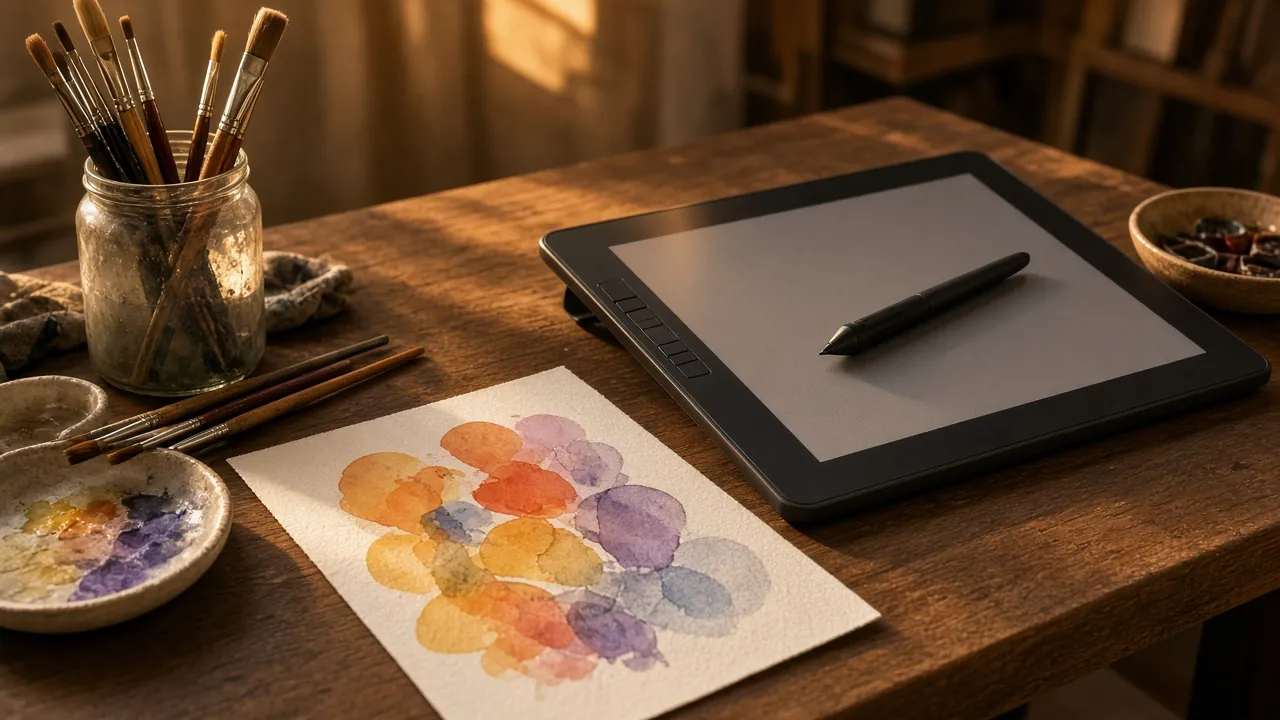
Have you ever looked at a breathtaking painting, heard a captivating melody, or read a gripping story and thought, “I wish I could do that”? For many of us, the dream of artistic creation remains just that – a dream. We might feel a spark of inspiration, a tug towards expressing something unique within us, but the practical skills, the years of dedicated practice, and the intimidating blank canvas often stand as insurmountable barriers. Drawing a straight line can be a challenge, let alone a majestic landscape or a compelling character. Composing music might feel like a dark art reserved for virtuosos, and writing a novel… well, that’s just asking for trouble, right?
What if I told you that those barriers are crumbling? What if the ability to paint stunning digital art, compose original music, or even write evocative poetry and short stories is now within your reach, regardless of your past artistic endeavors (or lack thereof)? Welcome to the exciting frontier of everyday creative expression, powered by artificial intelligence. You no longer need to spend years mastering a brushstroke, learning music theory, or perfecting grammatical structures. AI isn't here to replace human creativity; it's here to amplify it, to liberate the latent artist within everyone, even if your previous artistic achievements peaked with an expertly coloured kindergarten drawing.
Disclosure: Our guides are researched from the public sources we cite; we don't carry out hands-on product testing.
The Democratization of Creation: From Elite Skill to Everyday Tool
For centuries, artistic creation was often a painstaking journey, accessible primarily to those with natural talent, relentless dedication, and often, the financial means to pursue formal training. Think of the Renaissance masters, the classical composers, the celebrated authors. Their skills were honed over lifetimes, their techniques passed down through apprenticeships and academies. This created an admirable but also inherently exclusive sphere of creation.
The digital revolution began to chip away at this exclusivity, offering tools like Photoshop for graphic design or GarageBand for basic music production. These tools lowered the entry barrier somewhat, but still demanded a certain level of technical proficiency and understanding of artistic principles. You still needed to know how to use the software, what a good composition looked like, or how chords fit together.
Generative AI is a monumental leap beyond that. It's not just a tool; it's a co-creator, an intelligent assistant that understands your intent even when you struggle to articulate it. You don't need to know how to draw a dragon to conjure one into existence; you just need to describe the dragon you envision. You don't need to understand scales and arpeggios to create a calming ambient track; you just need to tell the AI the mood you want to evoke. This truly democratizes creation, putting powerful artistic capabilities into the hands of anyone with an idea and a willingness to explore.
Painting with Words: AI Image Generators
Perhaps the most sensational and visually striking example of AI's impact on personal creativity comes from image generation. Tools like Midjourney, DALL-E 3, and Stable Diffusion have swept across the internet, transforming simple text prompts into astonishing visual masterpieces. Imagine being able to:
- Visualise your wildest dreams: Ever had a vivid dream you wished you could capture? Describe it to an AI, and watch as it brings your subconscious landscape to life.
- Illustrate your personal stories: Writing a fanfiction or a personal journal? Generate unique concept art for your characters, settings, and pivotal moments.
- Design custom gifts and decor: Create bespoke artwork for T-shirts, mugs, posters, or even unique digital wallpapers for your devices.
- Unleash your inner architect or interior designer: Experiment with different home decor styles, visualise garden layouts, or even design your dream futuristic city just for fun.
- Craft unique avatars and profile pictures: Move beyond generic stock photos and create a truly personalised digital representation of yourself or your online persona.
The process is often as simple as typing a sentence: "A majestic dragon with iridescent scales perched on a snowy mountain peak at sunset, volumetric lighting, epic fantasy." Within moments, the AI will generate several variations based on your description. You can then refine your prompt, adding details like artistic styles ("oil painting," "cyberpunk," "anime style"), camera angles ("wide shot," "close-up"), or lighting conditions, until you achieve the desired result. The learning curve is surprisingly gentle, focusing more on descriptive language and iteration rather than technical drawing skills.
Composing Your Own Soundtrack: AI Music Creation
Beyond visuals, AI is also opening up the world of music composition. For years, learning an instrument or music theory felt like a Herculean task. Now, AI-powered music tools allow you to:
- Generate background music for personal videos: Create custom soundtracks for your home movies, travel vlogs, or family slideshows without worrying about copyright or needing to hire a composer.
- Experiment with different genres and moods: Want a funky retro synthwave track for your morning commute? Or a calming classical piece for meditation? Describe the vibe, instruments, and tempo you're looking for, and the AI will generate compositions.
- Develop unique soundscapes for gaming or role-playing: If you're a tabletop gamer or just enjoy immersive experiences, generate ambient soundscapes or battle themes tailored to your specific scenarios.
- Practice your own musical ideas: Generate backing tracks in various styles for you to sing or play along with, offering a personalised practice partner.
- Explore new sonic territories: Combine unlikely genres or instruments to create truly unique and experimental audio pieces, purely for personal enjoyment and exploration.
Tools like Amper Music, AIVA, and even some features within consumer-grade video editing software are utilising AI to transform text prompts or simple parameter adjustments into full musical compositions. You might specify "upbeat, acoustic guitar, folk song with a slightly melancholic feel" and receive a royalty-free piece perfect for your personal project. It’s an empowering way to engage with music beyond just listening, allowing you to shape the sounds around you.
The Written Word Reimagined: AI for Storytelling and Poetry
Perhaps one of the most intimate forms of personal expression is writing. Whether it's journaling, crafting fictional narratives, or penning poetry, the blank page can be an intimidating adversary. AI is becoming an incredible ally for aspiring writers and those who simply want to explore their narrative potential:
- Bypass writer's block: Stuck on how to start a story? Need a fresh idea for a plot twist? AI can generate countless suggestions, character profiles, setting descriptions, or even entire plot outlines based on your initial concepts.
- improve your journaling: Transform scattered thoughts into more cohesive and reflective entries. Use AI to help you articulate complex emotions or find the right words to describe an experience.
- Craft personalised poetry and prose: Experiment with different poetic forms, explore themes, or generate evocative imagery that you might not have considered yourself. Write a poem for a loved one, a whimsical short story for a child, or a descriptive passage for a personal blog. You can even instruct the AI to write in the style of a famous author for playful experimentation.
- Create interactive fiction: Ever wanted to write your own "choose your own adventure" story? AI can help you branch out narratives, generate different outcomes, and even create dynamic dialogues based on user choices.
- Learn and improve your writing: While not a tutor, interacting with AI-generated text can expose you to new vocabulary, sentence structures, and narrative techniques, subtly improving your own writing skills through exposure and experimentation.
Tools like ChatGPT, Jasper AI, and even integrated writing assistants in word processors are making this possible. You can prompt an AI with a simple idea like, "Write a short story about a grumpy wizard who loses his spellbook," and watch it unfold a narrative that you can then edit, expand upon, or simply enjoy as a springboard for your own creativity. It’s like having a tireless brainstorming partner who is always ready with new ideas and perspectives.
Beyond the Canvas: The Philosophical Shift and Your Creative Identity
Some might argue that using AI for art isn’t “real” art. That’s a valid discussion, but for personal creative expression, the line blurs significantly. The goal here isn't necessarily to become a famous artist (though who knows what doors might open!), but to engage with the creative process itself, to bring your inner world into tangible form, and to experience the joy of making something unique.
Think of AI not as a replacement for your imagination, but as an incredibly advanced paintbrush, a versatile instrument, or an infinitely patient editor. The initial spark, the concept, the intention – that still comes from you. The AI merely executes the technical aspects, freeing you from the drudgery of mastering specific tools and allowing you to focus on the what and the why of your creation.
This shift empowers you to:
- Reduce creative frustration: Spend less time struggling with technical limitations and more time exploring possibilities.
- Experiment fearlessly: Make mistakes, try wild ideas, and generate endless variations without wasting expensive materials or precious time.
- Discover hidden talents: You might not have known you had a knack for visual storytelling until you started generating images, or a flair for evocative descriptions until you prompted an AI for poetry.
- Build confidence: Seeing your ideas come to life, even with AI assistance, can be incredibly motivating and build confidence in your creative vision.
- Connect with your inner world: Use creation as a form of self-exploration and mindfulness, externalizing thoughts and feelings in new and engaging ways.
Getting Started: Your First Steps into AI Creativity
Ready to unleash your inner artist? Here’s how you can begin your journey:
- Start Simple: Don't aim for a cinematic masterpiece on day one. Begin with basic prompts for images or short text snippets.
- Experiment with Different Tools: Many AI tools offer free tiers or trials. Explore a few to see which interface and style resonate most with you. Midjourney (discord-based for images), DALL-E 3 (often integrated into ChatGPT Plus or Bing Image Creator), Stable Diffusion (various free online interfaces like Lexica Art or Hugging Face Spaces), ChatGPT (for text), or Google’s Bard are great places to start.
- Be Specific and Iterative with Prompts: The clearer and more detailed your instructions, the better the AI can understand your vision. Don't be afraid to add adjectives, artistic styles, emotions, and specific details. If the first output isn't quite right, refine your prompt and try again.
- Think Broadly: Don't limit yourself to just creating what you see. Explore concepts, moods, abstract ideas, or even mash-ups of unrelated concepts.
- Share (If You Want!): Share your creations with friends, family, or online communities. Getting feedback (and even just appreciation) can be a powerful motivator.
- Embrace the Fun: The most important thing is to enjoy the process. This isn't about perfection; it's about exploration, expression, and the sheer delight of bringing unique ideas into being.
Artificial intelligence is no longer a futuristic concept confined to sci-fi novels. It's a tangible, accessible force that is fundamentally changing how we interact with technology and, more profoundly, how we engage with our own creativity. Whether you've always yearned to paint, compose, or write, or if the idea of artistic expression simply sparks a newfound curiosity, the AI revolution is inviting everyone to step onto the creative stage. So, go ahead, describe your dreams, hum your melodies, and whisper your stories to the digital canvas. Your inner artist is ready to emerge, no drawing skills required.
Sources and further reading
Official and primary sources covering the topics in this article:
- AI regulation: a pro-innovation approach (GOV.UK): background on the UK's approach to regulating AI.
- Stanford HAI: AI Index report: background on independent data on AI progress and adoption.
- ICO: guidance on AI and data protection: background on UK data protection rules when using AI.
Frequently asked questions
What should you know about the Democratization of Creation: From Elite Skill to Everyday Tool?
For centuries, artistic creation was often a painstaking journey, accessible primarily to those with natural talent, relentless dedication, and often, the financial means to pursue formal training. Think of the Renaissance masters, the classical composers, the celebrated authors.
What should you know about Painting with Words: AI Image Generators?
Perhaps the most sensational and visually striking example of AI's impact on personal creativity comes from image generation. Tools like Midjourney, DALL-E 3, and Stable Diffusion have swept across the internet, transforming simple text prompts into astonishing visual masterpieces.
What should you know about Composing Your Own Soundtrack: AI Music Creation?
Beyond visuals, AI is also opening up the world of music composition. For years, learning an instrument or music theory felt like a Herculean task.
What should you know about the Written Word Reimagined: AI for Storytelling and Poetry?
Perhaps one of the most intimate forms of personal expression is writing. Whether it's journaling, crafting fictional narratives, or penning poetry, the blank page can be an intimidating adversary.
Related Articles
From Our Network
Sarah covers web hosting, SaaS tools, and developer infrastructure. She's tested 200+ hosting providers and built her first server at 14.
Last updated: 2026-04-25 · Fact-checked by editorial team
Content Attribution: All content on The AI Briefing HQ is original. External sources are attributed where applicable. Trademarks belong to their respective owners.